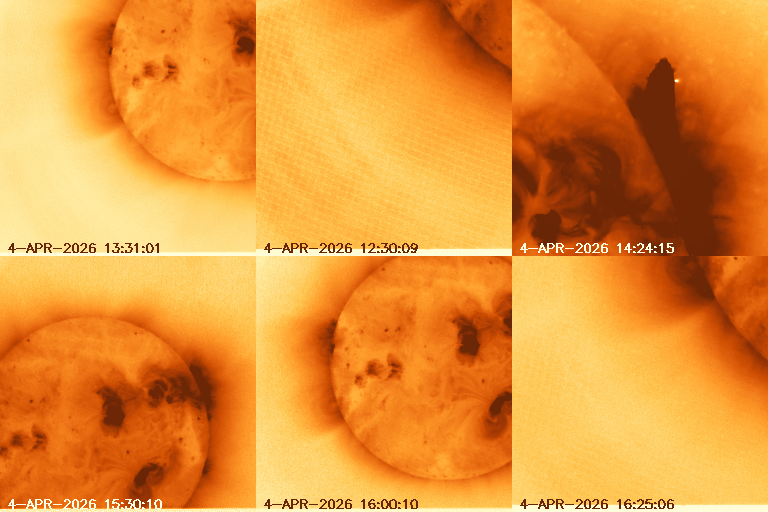
Collage of XRT images obtained at each Comet MAPS pointing. XRT_PREP and dust correction were applied.
Preparing for the Comet MAPS (C/2026 A1) Observation
|
This article was written for the record of our preparation for and outcome from the Comet MAPS (C/2026 A1) observation scheduled on April 4, 2026. Unfortunately, the comet broke down before reaching its perihelion, the main location of our observation, and thus nothing was detected in the obtained images. However, the preparation of the observing program took concentrated effort to create multiple complicated observing sequences in a short period of time. It is our desire that this record provides useful information for the next opportunity of comet observation, and that the observing sequences can be prepared more easily with plenty of time. [A] Prediction of comet location 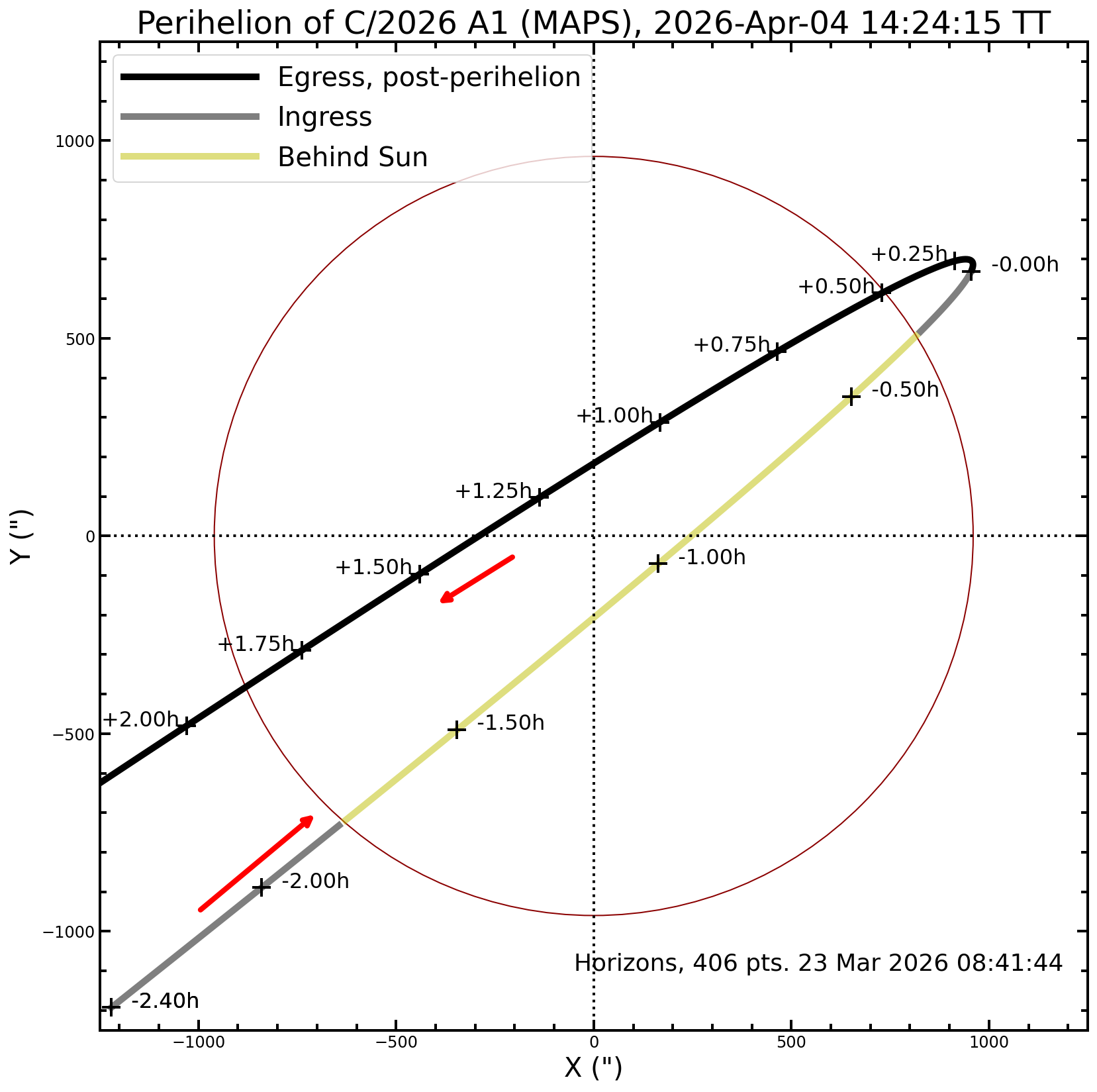
Prediction of the Comet MAPS location. Click to enlarge. [B] Observing plan HOP 527 (Comet MAPS) was included in the 20260404 timeline assembled by Joy Velasquez (XRTCO of the week at SAO). The pointing information was provided by Wei Liu (HOP527 PI) during the daily meeting on 4/3. --- date --- time ------- x / y (arcmin) --------- comment --------------- 2026/04/04 11:27:00 /* -800.0/ -520.0 : # OP start + 10min, HOP 527 #1 */ 2026/04/04 13:50:00 /* 840.0/ 480.0 : HOP 527 #2 */ 2026/04/04 15:04:00 /* 315.0/ 404.0 : HOP 527 #3 */ 2026/04/04 15:49:00 /* -508.0/ -170.0 : HOP 527 #4 */ 2026/04/04 16:20:00 /* -900.0/ -300.0 : HOP 527 #5 */ ---------------------------------------------------------------------------The HOP527 uses three XOBs at five separate pointings:
XRT was requested to use a 1024x1536 pixel FOV. However, the orbit of the comet did not appear to fit this rectangular FOV. We modified the FOV to a square shape (1024x1024) to save telemetry. XRT was requested to keep observing during the SAA passage. Therefore, we needed to remove Bad_Photo entry/exit commands during the comet observations. We also disabled flare control in the sequence so that comet observations would not be disturbed by flares. MDP_XRT_FLD_DIS MDP_XRT_FLRCTRL_DISThree new XOBs for HOP 527 were created by Keiji Yoshimura (XRTCO previous week) and tested in the 20260402 timeline. After the test run, some XOBs were modified. Below are their final forms. XOB#1D47:
[C] Obtained images Here are movies of the obtained images. Note that they are raw data, before applying XRT_PREP and dust correction. YouTube overview movie: link The title image above is a collage of images obtained at each pointing. XRT_PREP and dust correction were applied. However, stray light subtraction was not performed, because we do not know the stray light pattern for these particular pointings. The stray light component depends strongly on the satellite pointing, and we mainly measure it at disk center and limb pointings each year. [D] Some takeaways
[E] Reference: past comet observations by Hinode
Keywords: Flare Filters: Al_mesh |
(Prepared by Aki Takeda & Keiji Yoshimura & Rhiannon Fleming)
The XRT instrument team is comprised of SAO, NASA, JAXA, and NAOJ.
| Back | Archive | Next |