Click the image to view the movie, or watch it on YouTube.
A Stellar Tilt
|
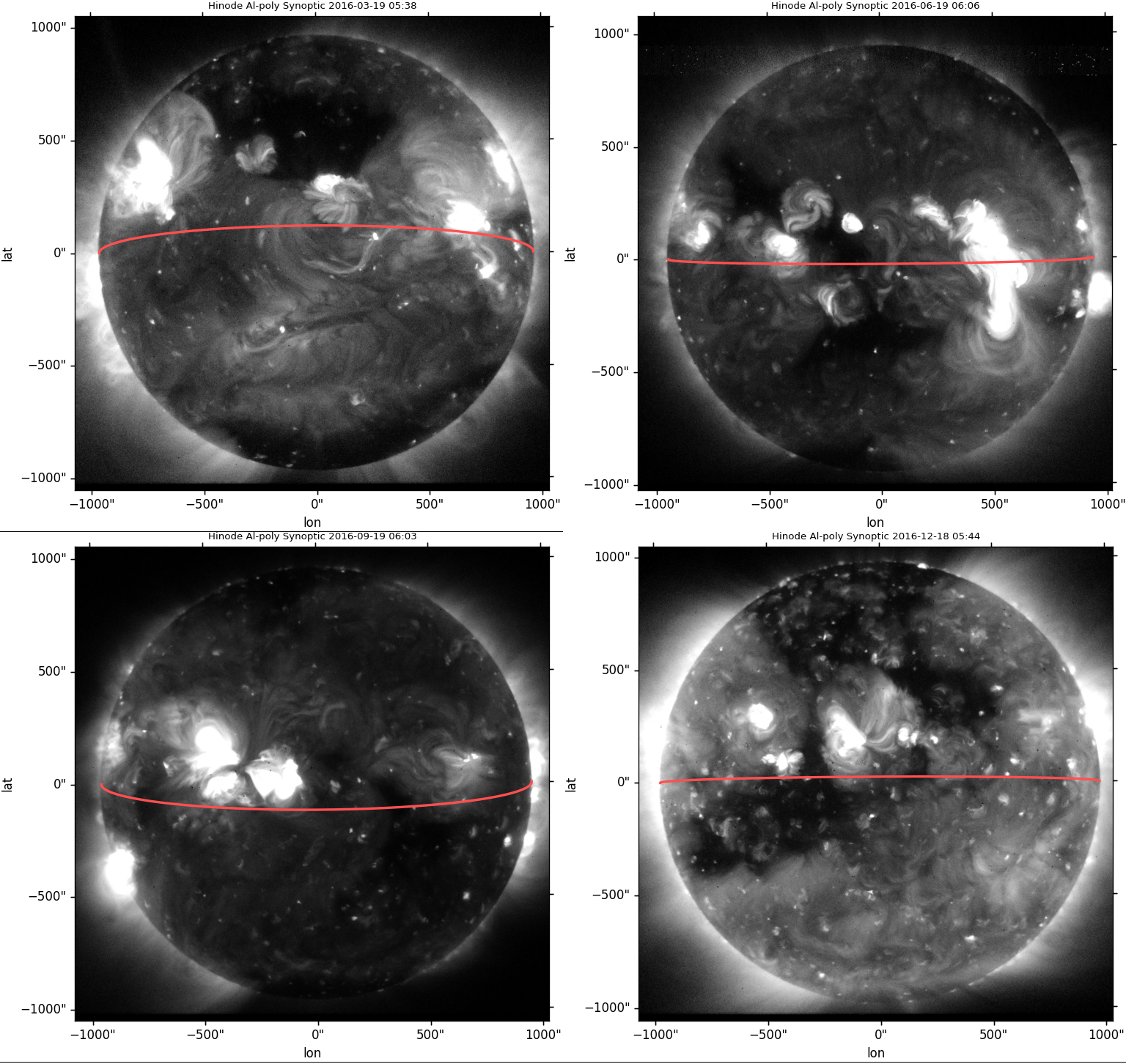
The planets of the solar system all have different tilts from the ecliptic plane, the 0° plane in which the Earth revolves around the Sun, as small as 0.01° (Mercury) to 177.3° (Venus). As it turns out, the Sun also has a tilt, but not as large as Earth's 23.4°. The Sun's tilt from the ecliptic plane is about 7.25°. While this does not sound like much, the little bit of tilt helps solar scientists better understand the Sun's poles, which would be impossible to see if the Sun had zero tilt. The Sun is not the only star with an axial tilt; through the Kepler mission, scientists have also been able to determine that stars across the galaxy have unique tilts. Additionally to unique tilts, the Earth does not orbit the Sun in a perfect circle. In January, the Earth is at a point called perihelion, or the point closest to the Sun. In July, the Earth is at aphelion, or the point furthest from the Sun. Notice that we are closest to the Sun during Northern Hemisphere winter and Southern Hemisphere summer, proving that the tilt away from the Sun is the real driver of wintertime, while tilt toward the Sun causes summertime. In the attached images and video, watch as the equatorial line shifts through the months. If you notice, the Sun's equator is at 0 degrees in both June and December while Earth's is usually above or below our 0 degrees (Summer and Winter Solstice). However, the Sun's equator is usually above or below 0 degrees in March and September when Earth's equator is close to 0 degrees (Autumnal and Vernal Equinox). This means the best time to observe the solar poles is in spring and fall. You will also see the Sun changing apparent size as the seasons change (as Earth reaches perihelion and aphelion). The X-Ray Telescope aboard the Hinode Solar Satellite (Solar-B) observes the poles closely at the beginning of each month to capture polar events such as jets and coronal holes. The images in the video were compiled from Al-poly composite synoptic images obtained from 2006 through 2024, where you can see not only the changing solar tilt and distance, but also a full solar cycle of activity. Keywords: Synoptic Filters: Al_poly |
(Prepared by Rhiannon Fleming)
The XRT instrument team is comprised of SAO, NASA, JAXA, and NAOJ.
| Back | Archive | Next |