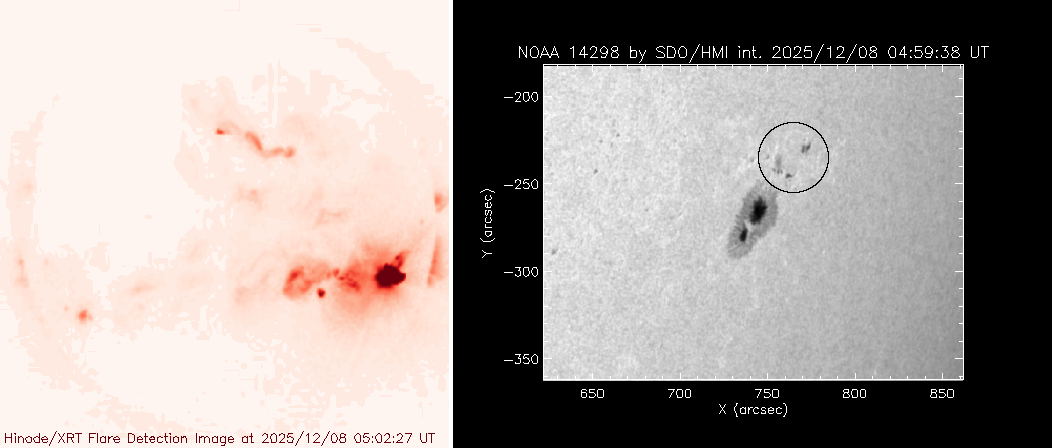
A GOES X1.1 flare occurred on 2025 December 8. Click the image to watch the XRT flare-detection movie, or view the YouTube version here.
An X from an Alpha!
|
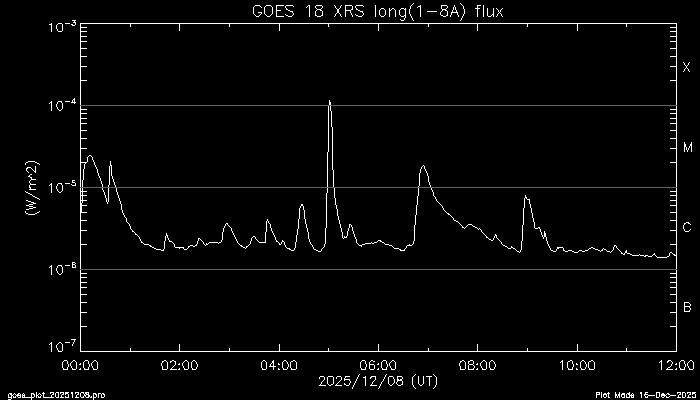
A GOES X1.1-class flare was reported on 8 December 2025 (see the GOES/XRS plot). At the time of the flare (~5 UT), XRT was running a CME-watch program (full-Sun observations). However, the cadence was too low to capture the flare evolution well, and only a few images were obtained—many of them uncorrectably saturated. Fortunately, the flare was captured by a series of XRT FLD images (256×256 full-Sun, ~30-second cadence flare-detection images), as shown in this movie (YouTube: link). Interestingly, on the day of this flare, AR14298 was reported as an unipolar sunspot group—an alpha-type region in the Mount Wilson magnetic classification. This is the simplest class of sunspot group, and it rarely produces major flares. So how did an apparently simple alpha region produce an X-class event? To investigate, I examined SDO/HMI sunspot visible-continuum images of AR14298 every 12 hours from 24 hours before to 24 hours after the flare. In this HMI movie (YouTube: link), newly emerged sunspots appear just north of AR14298 about 12 hours before the flare—and they nearly disappear by 24 hours after. Although AR14298 was reclassified as a beta-type region starting the next day because of these short-lived spots, this event shows one way an “alpha” sunspot can produce an X-class flare: rapid, nearby flux emergence can quickly change the magnetic complexity and enable major activity. Keywords: Flare Filters: Al_poly |
(Prepared by Aki Takeda)
The XRT instrument team is comprised of SAO, NASA, JAXA, and NAOJ.
| Back | Archive | Next |