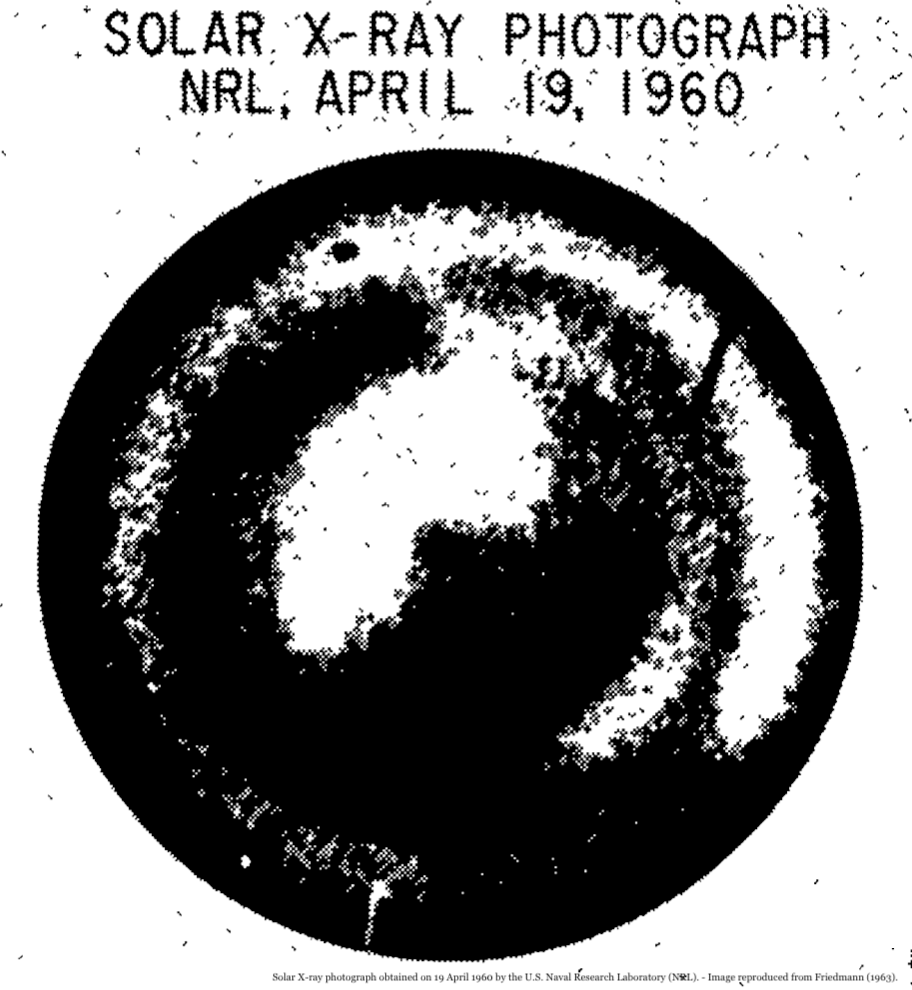
Left: One of the first solar X-ray photographs, taken by the U.S. Naval Research Laboratory (NRL) on April 19, 1960, using a sounding rocket.
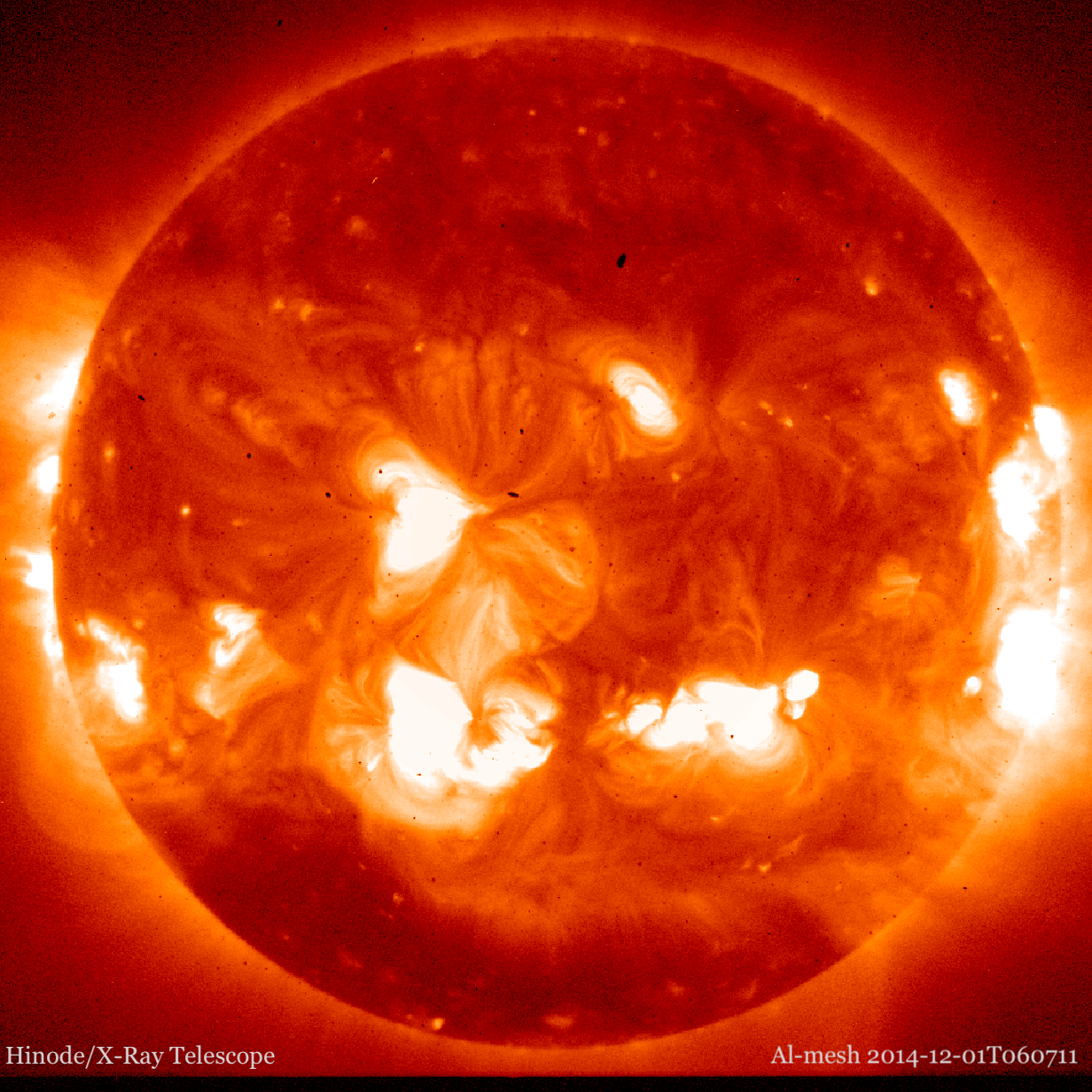
Right: A modern Hinode/XRT X-ray view of the Sun, showing hot coronal plasma, flares, and magnetic loop structures.
From the First Solar X-Rays to Hinode/XRT
|
Today, the Hinode X-Ray Telescope (XRT) stands on the shoulders of decades of solar X-ray missions—such as Yohkoh, RHESSI, and modern sounding-rocket experiments like MaGIXS. Yet the roots of solar X-ray astronomy reach back to the late 1950s and early 1960s, when the field was just beginning. At the center of that story is Herbert Friedman, a pioneering scientist at the U.S. Naval Research Laboratory (NRL) and widely regarded as the father of solar X-ray astronomy. A surprising discovery Earth’s atmosphere blocks X-rays completely. For most of human history, the Sun’s hottest and most energetic activity was invisible. In the early 1960s, satellites and sounding rockets launched during the Cold War uncovered something unexpected: the Sun itself was shining brightly in X-rays. Friedman brought these discoveries together in his landmark 1963 paper, “Solar X-Rays”. For the first time, the Sun was recognized as a persistent and highly variable X-ray source, especially during solar flares. His work demonstrated that:
From prediction to precision Near the end of his 1963 review, Friedman wrote that “more sophisticated solar X-ray observatories will undoubtedly be placed in orbit in the near future.” More than sixty years later, Hinode/XRT fulfills that vision—mapping the structure, temperature, and evolution of the million-degree solar corona with extraordinary clarity. Bright regions trace hot plasma, flares reveal rapid magnetic energy release, and graceful loop structures outline the Sun’s invisible magnetic field. What began as an accidental Cold War discovery has become one of our most powerful tools for understanding how the Sun works—and how solar activity shapes the space environment around Earth. Every XRT image carries that legacy forward. Keywords: Synoptic Filters: Al_mesh |
(Prepared by Joy Velasquez)
Historic image credit: U.S. Naval Research Laboratory (NRL). Solar X-ray photograph from sounding rocket experiment, April 19, 1960.
The XRT instrument team is comprised of SAO, NASA, JAXA, and NAOJ.
| Back | Archive | Next |