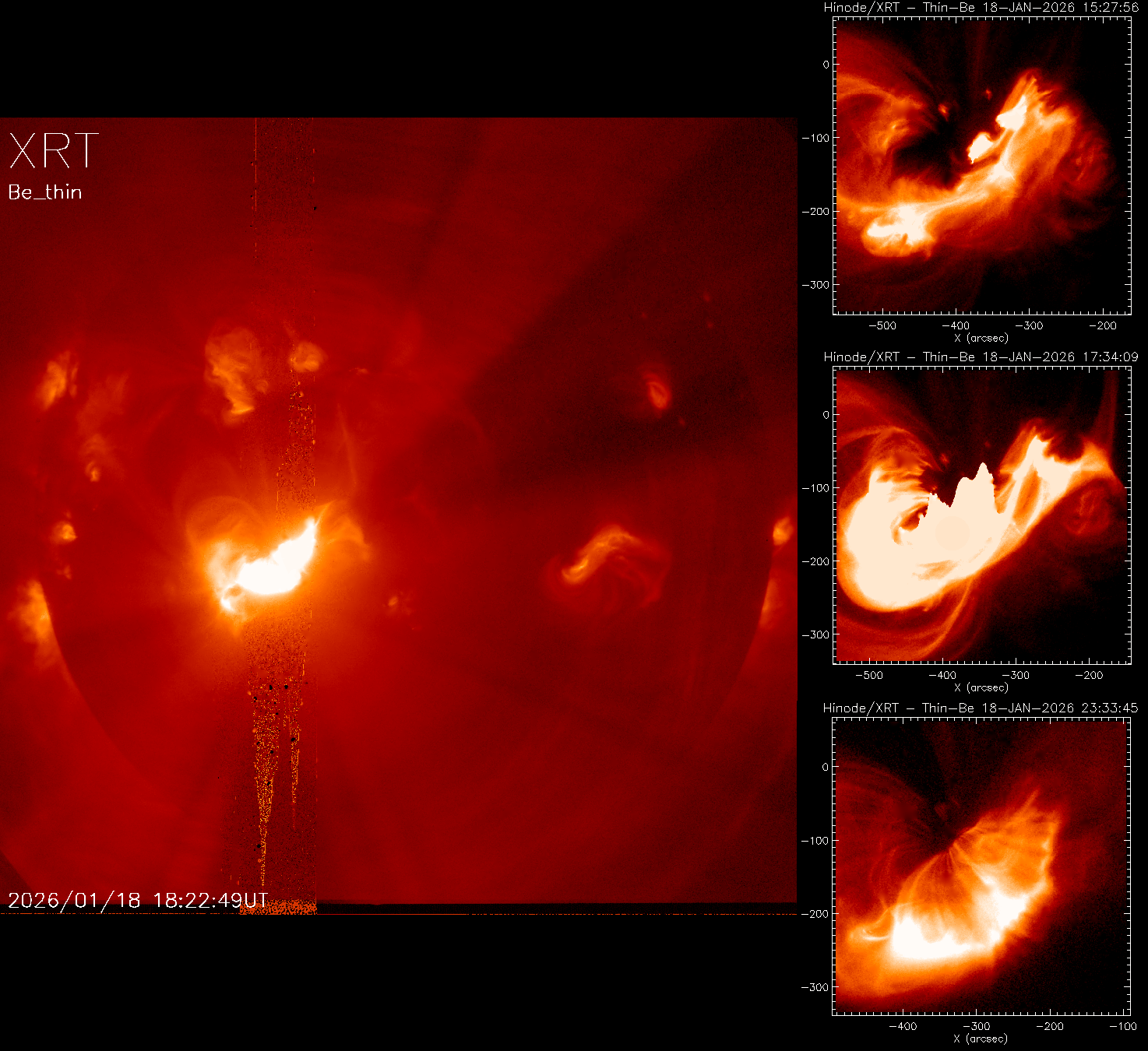
Click the image to watch the movie of the January 18, 2026 GOES X1.9 flare from AR14341 (Hinode/XRT, Thin-Be).
One Event, Three Types of Greatness with AR14341
|
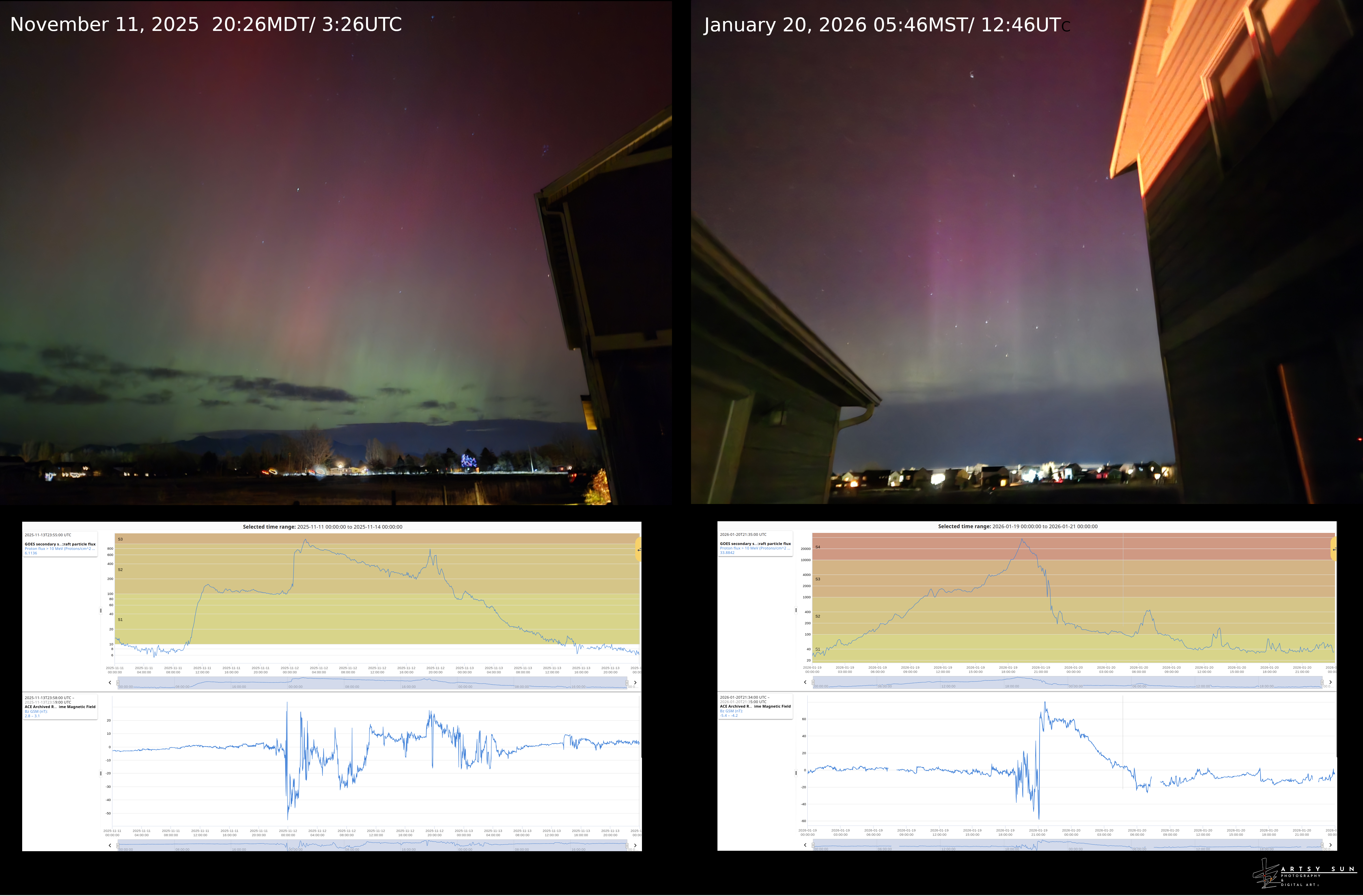
On January 18 a GOES X1.9 flare launched from active region (AR) 14341. Headlines from numerous news networks including CNN (link) reported this event is the strongest in over 20 years. But wait, didn't we have a larger X5.1 class flare (link) last November? As a matter of fact, there is more than one right way to evaluate the impact of solar flares, just like the Academy Awards have several categories to nominate. The following three metrics are the commonly used categories for solar flares: strength of soft X-ray emission, number of high energy particles arriving at Earth, and the impact on Earth’s geomagnetic fields. The top flare in one category tends to be so in other two categories, but that’s not always true. Let's take a look at the case of the X1.9 flare produced by AR14341 on January 18, 2026. 1) Soft X-ray emission: The Sun is constantly emitting low levels of X-ray light, but flares are particularly explosive in this type of light. Sun's X-ray radiation gives energy to Earth's atmospheric particles and makes the ionosphere denser and thicker, which may cause disturbance in radio communication, radio navigation, increase of satellite drag for low-earth orbit satellites. For a bit more depth about flares, see this previous XPOW (link). In the case of the January 18 event, GOES detected an X1.9 class flare (1.9x10^-4 W/m^2) peaked at 18:09 UT. This is the highest rank of solar flares, but there was an X5.1 flare on November 11, 2025, which is more than 2.5 times stronger than the X1.9 flare. The largest event in this solar cycle (No.25 started in 2020) is an X9.1 flare that occurred on October 3, 2024. 2) Number of high energy particle arrived at Earth: At approximately 19:00 UT on January 19th, the Advanced Composition Explorer (ACE) detected a sharp surge in solar protons which is the sign of an incoming solar radiation storm. While the Sun constantly emits a solar wind of charged particles, sudden spikes like this pose a significant threat to technology and transit. To monitor these events, we rely on two-tiered monitoring: ACE, positioned at Lagrange Point 1 (L1) to act as an early-warning buoy, and GOES-18 in high Earth orbit to measure local impact. This particular storm escalated to an S4 powerful radiation event in 23 years. Such a severe storm's effects are widespread, triggering intensity (out of 5 -- add image "solar_radiation_storm_levels.png"), making it the most vibrant auroras while disrupting GPS systems, satellites like Hinode, and increasing radiation exposure for high-latitude flights and astronauts. 3) Impact on geomagnetic field: The final part of these multiple impact events are geomagnetic storms. These are the CME itself, a magnetic field wrapped in more plasma. This magnetic field’s shape is a mystery until interacting with our satellites. The z-direction of a CME’s magnetic field determines how much impact there will be. In the positive direction, the CME’s magnetic field aligns with Earth’s creating a less impactful storm. If in the negative direction, Earth’s magnetic field is battered and allows for more of the charged particles to spiral down to our atmosphere. This past geomagnetic storm reached G4 storming and Kp 8.6 levels, which is a powerful storm, but not the most impactful geomagnetic storm of this cycle which was on May 11, 2024 at a G5 storm and Kp index of 9.0. The January 19th storm also aligned with our magnetic field, so while there was a powerful solar radiation storm, the geomagnetic connection caused a less potent show of aurora aurora comparison link. In the image, you’ll see greater color and sky coverage from the November event (G4, Kp 8.9, S3) with less radiation storming, but a majority negative magnetic field. On the right is the last storm in January with a powerful storm, but the positive magnetic field produces an aurora show that isn’t as bright or deeply colored. Note that the graphs are from both GOES and ACE as both have particular specialities, so the storming and CME impact may look like they’re at the same time, but are not. The movie is made of Thin-Be images taken from Hinode’s X-ray Telescope (XRT) of the January 18th X1.9 flare, link.. In the title synoptic image, there are visual artifacts due to oversaturation of all three images taken during the flaring. Keywords: Flare Filters: Thin_Be |
(Prepared by Rhiannon Fleming & Aki Takeda)
The XRT instrument team is comprised of SAO, NASA, JAXA, and NAOJ.
| Back | Archive | Next |