| 
|
XRT
(SAO, NASA, JAXA, NAOJ)
Hinode (was Solar-B) was launched at 6:36 a.m. on September 23, 2006 (Japan Standard Time).
2024-April-08
New XPOW:
The Great American Eclipse: From the Ground to Space
2024-March-30
New XPOW:
M Flares from AR13615
2024-March-04
New XPOW:
A Sparkling Active Region: AR13576
2024-February-09
New XPOW:
M-Class Flares Produce Post-Flare Loops
2024-February-01
New XPOW:
Quality over Quantity: New Year ARs 2024
2024-January-29
New XPOW:
End of the Year Fireworks 2023
2023-December-19
New XPOW:
Cycle 25 Expressions of the Sun
2023-December-15
New XPOW:
Major Holiday Pops!
2023-December-08
New XPOW:
AR13500: Starting off the Holiday Season with a Pop
2023-October-14
New XPOW:
Ring of Fire in the Sky
2023-August-11
New XPOW:
Probing Solar Flares: Unveiling Insights with XRT Data, XRTpy Analysis, and CHIANTI Database
2023-August-07
New XPOW:
Flaring Region AR13376
2023-July-31
New XPOW:
Gamma Shape On the Sun
2023-July-27
New XPOW:
X Flare Image Made in Python
2023-June-29
New XPOW:
Busy Start to a Busy Summer
2023-May-23
New XPOW:
An Unrecorded Flare from AR13297
2023-May-18
New XPOW:
Eclipse Down Under
2023-May-15
New XPOW:
Amazingly Active Active Region 13296
2023-April-01
New XPOW:
3 Years Of Solar Cycle 25 In 3 Minutes
2023-March-09
New XPOW:
Flaring Sun to Celebrate Hinode's 6000 days
2023-March-07
New XPOW:
Cusp and Arcades of AR13229
2023-February-28
New XPOW:
Active Start for a (hopefully) Active Year
2023-February-16
New XPOW:
CME Aftermath: 27 January 2023
2023-February-02
New XPOW:
A week of Flares: January 2023
2023-January-13
New XPOW:
Active Start for an Active Month
2022-December-22
New XPOW:
End of Year Fireworks
2022-December-20
New XPOW:
November 2022 Flare Watch on AR13141
2022-November-28
New XPOW:
Last Gasp of AR13110
2022-November-17
New XPOW:
Autumnal Equinox and A Unique CME
2022-November-15
New XPOW:
Reimagining the October 2022 Eclipse
2022-October-31
New XPOW:
Twinkling Eye on a Spooky Halloween Face
2022-October-25
New XPOW:
October 2022 Eclipses
2022-July-22
New XPOW:
2.5 years of Cycle 25 in 2.5 Minutes
2022-July-15
New XPOW:
Expressive Face of the Sun
2022-July-13
New XPOW:
Goodbye Active AR Group
2022-June-23
New XPOW:
AR Group Still Active After 2 Rotations
2022-May-24
New XPOW:
15 Years of Spectacular Observations - II
2022-April-20
New XPOW:
Solar Activity Continues!
2022-April-14
New XPOW:
Solar Activity Picks Up!
2022-February-07
New XPOW:
15 Years of Spectacular Observations
2021-December-07
New XPOW:
Antarctic Eclipse 2021
2021-November-22
New XPOW:
Spooky Evolution of October ARs
2021-October-28
New XPOW:
XRT Sees X-Class Flare
2021-July-30
New XPOW:
MaGIXS Rocket Coordination
2021-June-14
New XPOW:
June 2021 Solar Eclipse
2021-May-30
New XPOW:
Major Flare Sequence From AR12824
2021-May-20
New XPOW:
Another M-class flare from the E-limb!
2021-April-06
New XPOW:
Things Change and Things Stay the Same
2021-January-17
New XPOW:
Coordination with Parker Solar Probe Encounter 7
2020-December-10
New XPOW:
M4.4 Class Flare from AR12790
2020-September-15
New XPOW:
Offical Cycle 25 Horseshoe Region
2020-June-21
New XPOW:
Summer Solstice Eclipse
2020-April-30
New XPOW:
Turbulent Times
2020-March-11
New XPOW:
Glorious days of the Sun with a clover shaped AR
2020-February-21
New XPOW:
PSTEP Solar Cycle 2009-2019
2020-February-12
New XPOW:
Coordination with Parker Solar Probe
2020-January-02
New XPOW:
Post-Christmas Annular Eclipse
2019-December-09
New XPOW:
The Life and Death of AR 12752
2019-December-04
New XPOW:
2020 Hinode XRT Wall Calendar
2019-November-27
New XPOW:
Solar Activity Belts
2019-November-14
New XPOW:
Mercury with a Quiet X-ray Sun
2019-November-07
New XPOW:
A Cycle 25 Active Region Making its Passage
2019-September-14
New XPOW:
A Transient's a Transient, No Matter How Small
2019-August-14
New XPOW:
Deep Observation of the Quiet Sun
See the XRT News page for older XRT news items.
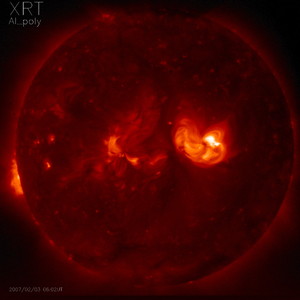
The Hinode X-Ray Telescope (XRT) is a high-resolution grazing-incidence telescope, which is a successor to the highly successful Yohkoh Soft X-Ray Telescope (SXT). A primary purpose of the Hinode XRT is to observe the generation, transport, and emergence of solar magnetic fields, as well as the ultimate dissipation of magnetic energy in forms such as flares and pico-flares, coronal heating, and coronal mass ejections. The XRT aboard Hinode observes the dissipation part of the life-cycle story of solar magnetic fields. High-resolution soft X-ray images reveal magnetic field configuration and its evolution, allowing us to observe the energy buildup, storage and release process in the corona for any transient event. One of the unique features of XRT is its wide temperature coverage to see all the coronal features that are not seen with any normal incidence telescope.
The XRT consists of the X-ray and visible light optics, focal plane mechanisms (filters and shutter), and the 2k x 2k CCD camera. The Mission Data Processor (MDP) also plays a vital role for XRT.
The XRT was designed and developed by the Japan-US collaboration between Smithsonian Astrophysical Observatory (SAO), NASA MSFC, JAXA, and NAOJ. The XRT telescope was tested and calibrated at the XRCF at MSFC, and the CCD camera was tested and calibrated in X-rays at the ATC of the NAOJ with JAXA.
If XRT data is used in a published article or report, please give a proper Acknowledgement:
"Hinode is a Japanese mission developed and launched by ISAS/JAXA, with NAOJ as domestic partner and NASA and STFC (UK) as international partners. It is operated by these agencies in co-operation with ESA and the NSC (Norway)."
If an XRT image is displayed in a popular article, on a website, et cetera, then please acknowledge the contributing institutions:
"(SAO, NASA, JAXA, NAOJ)"
You may find a list of the XRT instrument papers and other important references that should be considered for inclusion in your XRT science paper HERE.
| Security Notice | Privacy Policy |