XRT: News Items
Latest News at Top
2026-March-05
New XPOW:
Preparing for the Comet MAPS (C/2026 A1) Observation
2026-March-05
New XPOW:
The Living Sun in X-rays
2026-February-11
New XPOW:
One Event, Three Types of Greatness with AR14341
2026-February-03
New XPOW:
From the First Solar X-Rays to Hinode/XRT
2026-January-21
New XPOW:
An X from an Alpha!
2026-January-07
New XPOW:
Size Up with AR14274
2025-December-16
New XPOW:
An X5.1 candle flame from AR14274
2025-December-02
New XPOW:
Coronal Hole is Not so Cool!?
2025-October-16
New XPOW:
Solar Butterfly: A Uniquely Shaped Coronal Hole
2025-September-24
New XPOW:
Another Solar Eclipse for XRT
2025-September-23
New XPOW:
19 Years of Hinode/XRT Observations
2025-August-01
New XPOW:
Solar Pops from AR14114
2025-July-18
New XPOW:
A Suddenly X-Ray Visible Filament
2025-July-01
New XPOW:
A Solar Summer Sendoff
2025-June-12
New XPOW:
A Lucky Call: Choosing ARs during Operations
2025-May-04
New XPOW:
Jetting off the Sun with AR14036
2025-March-29
New XPOW:
Mission to Capture a Sliver of the Sun
2025-March-25
New XPOW:
Solar Trefoil: AR14000
2025-March-18
New XPOW:
Love at First Site
2025-March-11
New XPOW:
We Found You, Moon!
2025-February-03
New XPOW:
Flares and Sunspots: A Look at AR13947
2024-December-05
New XPOW:
Hinode/XRT Stamps
2024-December-04
New XPOW:
Delta, Delta, Delta!
2024-December-03
New XPOW:
2024 Halloween Flare and Transiting Two Ghosts
2024-October-29
New XPOW:
Grumpy Solar Event: the South Pacific Annular Solar Eclipse
2024-October-02
New XPOW:
Super Active 2024
2024-September-20
New XPOW:
Unlocking Solar Insights Using XRTpy
2024-August-15
New XPOW:
Stellar Anemones: AR13761
2024-June-07
New XPOW:
There and Back Again -- An Active Region's Journey
2024-April-08
New XPOW:
The Great American Eclipse: From the Ground to Space
2024-March-30
New XPOW:
M Flares from AR13615
2024-March-04
New XPOW:
A Sparkling Active Region: AR13576
2024-February-09
New XPOW:
M-Class Flares Produce Post-Flare Loops
2024-February-01
New XPOW:
Quality over Quantity: New Year ARs 2024
2024-January-29
New XPOW:
End of the Year Fireworks 2023
2023-December-19
New XPOW:
Cycle 25 Expressions of the Sun
2023-December-15
New XPOW:
Major Holiday Pops!
2023-December-08
New XPOW:
AR13500: Starting off the Holiday Season with a Pop
2023-October-14
New XPOW:
Ring of Fire in the Sky
2023-August-11
New XPOW:
Probing Solar Flares: Unveiling Insights with XRT Data, XRTpy Analysis, and CHIANTI Database
2023-August-07
New XPOW:
Flaring Region AR13376
2023-July-31
New XPOW:
Gamma Shape on the Sun
2023-July-27
New XPOW:
X Flare Image Made in Python
2023-June-29
New XPOW:
Busy Start to a Busy Summer
2023-May-23
New XPOW:
An Unrecorded Flare from AR13297
2023-May-18
New XPOW:
Eclipse Down Under
2023-May-15
New XPOW:
Amazingly Active Active Region 13296
2023-April-01
New XPOW:
3 Years of Solar Cycle 25 in 3 Minutes
2023-March-09
New XPOW:
Flaring Sun to Celebrate Hinode's 6000 days
2023-March-07
New XPOW:
Cusp and Arcades of AR13229
2023-February-28
New XPOW:
Active Start for a (hopefully) Active Year
2023-February-16
New XPOW:
CME Aftermath
2023-February-02
New XPOW:
A week of Flares: January 2023
2023-January-13
New XPOW:
Active Start for an Active Month
2022-December-22
New XPOW:
End of Year Fireworks
2022-December-20
New XPOW:
November 2022 Flare Watch on AR13141
2022-November-28
New XPOW:
Last Gasp of AR13110
2022-November-17
New XPOW:
Autumnal Equinox and A Unique CME
2022-November-15
New XPOW:
Reimagining the October 2022 Eclipse
2022-October-31
New XPOW:
Twinkling Eye on a Spooky Halloween Face
2022-October-25
New XPOW:
October 2022 Eclipses
2022-July-22
New XPOW:
2.5 years of Cycle 25 in 2.5 Minutes
2022-July-15
New XPOW:
Expressive Face of the Sun
2022-July-13
New XPOW:
Goodbye Active AR Group
2022-June-23
New XPOW:
AR Group Still Active After 2 Rotations
2022-May-24
New XPOW:
15 Years of Spectacular Observations - II
2022-April-20
New XPOW:
Solar Activity Continues
2022-April-14
New XPOW:
Solar Activity Picks Up!
2022-February-07
New XPOW:
15 Years of Spectacular Observations
2021-December-07
New XPOW:
Antarctic Eclipse 2021
2021-November-22
New XPOW:
Spooky Evolution of October ARs
2021-October-28
New XPOW:
XRT Sees X-Class Flare
2021-July-30
New XPOW:
MaGIXS Rocket Coordination
2021-June-14
New XPOW:
June 2021 Solar Eclipse
2021-May-30
New XPOW:
Major Flare Sequence from AR12824
2021-May-20
New XPOW:
Another M-class Flare from the E-limb!
2021-April-06
New XPOW:
Things Change, Things Stay the Same
2021-January-17
New XPOW:
Coordination with Parker Solar Probe Encounter 7
2020-December-10
New XPOW:
M4.4 Class Flare from AR12790
2020-September-15
New XPOW:
Offical Cycle 25 Horseshoe Region
2020-June-21
New XPOW:
Summer Solstice Eclipse
2020-April-30
New XPOW:
Turbulent Times
2020-March-11
New XPOW:
Glorious days of the Sun with a clover shaped AR
2020-February-21
New XPOW:
Solar Cycle 2009-2019
2020-February-12
New XPOW:
Coordination with Parker Solar Probe
2020-January-02
New XPOW:
Post-Christmas Annular Eclipse
2019-December-09
New XPOW:
The Life and Death of AR 12752
2019-December-04
New XPOW:
2020 Hinode XRT Wall Calendar
2019-November-27
New XPOW:
Solar Activity Belts
2019-November-14
New XPOW:
Mercury with a Quiet X-ray Sun
2019-November-07
New XPOW:
A Cycle 25 Active Region Making its Passage
2019-September-14
New XPOW:
A Transient's a Transient, No Matter How Small
2019-August-14
New XPOW:
Deep Observation of the Quiet Sun
2019-August-06
New XPOW:
A Vigorous Jet from the Quietest Sun
2019-July-22
New XPOW:
A Tiny Sigmoid Erupted in Obscurity ...
2019-April-03
New XPOW:
Interacting Polar Jets
2019-February-26
New XPOW:
XRT Watches as the Moon Flashes Far Side to Sun
2019-February-12
New XPOW:
From XRT with Love
2019-January-30
New XPOW:
Polar Coronal Jets
2018-December-11
New XPOW:
2019 XRT Wall Calendar
2018-October-23
New XPOW:
Hinode XRT, SDO AIA and NuSTAR observe the Quiet Sun
2018-October-03
New XPOW:
Quiet Sun Filament Unraveling
2018-August-17
New XPOW:
The Sigmoid Catalog
2018-July-31
New XPOW:
The X-Ray Bow at the End of the Storm
2018-June-29
XAG update:
X-Ray Telescope Analysis Guide
2018-June-26
New XPOW:
Solar X-Ray Highlighter
2018-May-08
New XPOW:
Temperature Structure of an Active Region
2018-May-01
New XPOW:
MinXSS-1 Data consistency with Hinode XRT, GOES XRS, and SDO AIA Observations
2018-March-21
New XPOW:
Demystifying Coronal Holes
2018-March-06
New XPOW:
The Winsome Candle Flame Cusp
2018-February-27
New XPOW:
Scintillating Sun
2018-February-06
New XPOW:
Filament Erupts Causing B9.6 Solar Flare
2018-January-16
New XPOW:
Solar Cycle 24 -- part II
2018-January-09
New XPOW:
Trend-Busting Active Region Emerges in South
2017-December-12
New XPOW:
CME Creation
2017-December-05
New XPOW:
2018 XRT Wall Calendar
2017-November-28
New XPOW:
Solar Cycle 24
2017-November-21
New XPOW:
Peeling an Active Region
2017-November-07
New XPOW:
The Slinky Jet
2017-October-31
New XPOW:
The First Microflare Observations with Hinode/XRT & NuSTAR
2017-September-26
New XPOW:
Jet Blasts Through Active Region's Coronal Loops
2017-September-12
New XPOW:
X-flare-aganza!
2017-September-05
New XPOW:
Two More Episodes of the Great American Eclipse
2017-August-22
New XPOW:
The Great American Eclipse
2017-August-15
New XPOW:
How to Prevent Your Solar Eclipse Fun from Waning
2017-July-25
New XPOW:
The Sun's Ever Changing Magnetic Field
2017-July-18
New XPOW:
Active Region Flares Due to Magnetic Reconnection
2017-June-20
New XPOW:
XRT Focus Mode Catalog
2017-June-13
New XPOW:
A Small Eruptive Event
2017-May-23
New XPOW:
High Cadence Mircoflare
2017-May-02
New XPOW:
Slow Moving Shadow in X-rays
2017-April-25
New XPOW:
XRT Level0 Data MPEG Movie Archive
2017-April-24
New Observation Resource: XRT Level0 Data MPEG Movie Archive
This website provides MPEG movies of the XRT Level0 data. Users of XRT data can
now quickly check data availability and quality before accessing the archive. The archive is listed under the "Data" tab on the XRT webpages.
2017-April-18
New XPOW:
The Twilight of an Active Region
2017-April-11
New XPOW:
Sun's April Fools' Day Prank Leaves Solar Scientists Tickled Pink
2017-March-28
New XPOW:
Coldest Solar Corona Since 2009
2017-March-21
New XPOW:
Our Quiet Sun in X-rays
2017-March-07
New XPOW:
Catching Fire
2017-March-02
New XRT paper: "A Bayesian Approach to Period Searching in Solar Coronal Loops" by Bryan Scherrer, & David McKenzie was published in The Astrophysical Journal.
2017-February-28
New XPOW:
A Void Left After a Filament Eruption
2017-February-14
New XPOW:
Solar Filament Gets Zapped into X-ray Oblivion
2017-February-07
New XPOW:
Roses are red, violets are blue...
2017-January-24
New XPOW:
A Solar Sneeze
2017-January-10
New XPOW:
Coronal Jets and Wisps
2016-December-20
New XPOW:
Happy Winter Solstice
2016-December-13
New XPOW:
The Aftereffects of Flaring
2016-December-06
New XPOW:
Solar Fury
2016-November-29
New XPOW:
2017 XRT Wall Calendar
2016-November-22
New XPOW:
The Solar Cycle Clock
2016-November-15
New XPOW:
A New View of an Old CME -Thanks to Helioviewer.org
2016-November-08
New XPOW:
The Delightful Candle Flame Cusp
2016-November-01
New XPOW:
An Active Island Inside a Dark Coronal Hole
2016-October-04
New XPOW:
Magnetic Domes, Loops, and Lines
2016-September-27
New XPOW:
The Bubble Flare
2016-September-20
New XPOW:
Hinode: 10th Anniversary of Its Launch
2016-September-07
New XPOW:
Flare Cusp
2016-August-30
New XPOW:
The XRT Solar Flare Catalog
2016-August-23
New XPOW:
Dark and Bright Chewy Nougats
2016-August-16
New XPOW:
A Chip Off the Old Block
2016-August-09
New XPOW:
Together, they made the Sun great again! -- part II
2016-August-02
New XPOW:
Together, they made the Sun great again! -- Part I
2016-July-26
New XRT paper: "X-Raying the Dark Side of Venus - Scatter from Venus Magnetotail?" by
Afshari, M., Peres, G., Jibben, P. R., Petralia, A., Reale, F., and Weber, M. was accepted for publication in The Astrophysical Journal.
New XPOW: Solar Active Region Blooms
2016-July-20
New XPOW:
New Group of Active Regions
2016-July-06
New XPOW:
On this day...
2016-June-28
New XPOW:
XRT Observes Source of CME
2016-June-07
New XPOW:
A Spot-Free Sun
2016-May-24
New XRT paper: "Global Sausage Oscillation of Solar Flare Loops Detected by the Interface Region Imaging Spectrograph" by Hui Tain, Peter R. Young, Katharine K. Reeves, Tongjiang Wang, Patrick Antolin, Bin Chen, and Jiansen He was published in The Astrophysical Journal Letters.
New XPOW: A Tiny Coronal Cavity
2016-May-17
New XPOW:
Plasma Voids After a Solar Flare
2016-May-10
New XPOW:
Mercury Steals the Show
2016-May-03
New XPOW:
The Transit of Mercury
2016-April-26
New XPOW:
Hot Loop Causes Heat Wave in the South
2016-April-20
New XPOW:
The Story of Hinode
2016-April-12
New XPOW:
A Coronal Cavity Gets a Chewy Nougat
2016-April-05
New XPOW:
XRT joins GitHub!
2016-March-29
New XPOW:
Lightning Strikes
2016-March-22
New XPOW:
XRT Flare Catalog
2016-March-15
New XPOW:
Moon Blocks X-rays from Sun
2016-March-08
New XPOW:
One Active Region, Three Ways
2016-March-01
New XPOW:
The Coolest Plasmas Form the Hottest Trends
2016-February-23
New XPOW:
Lassoing an Active Region
2016-February-16
New XPOW:
Active Region Tug of War
2016-February-09
New XPOW:
Hinode XRT Digital Valentine's Day Cards
2016-February-02
New XPOW:
A Magnetic Null and Cool Reconnection
2016-January-26
New XPOW:
An Active Region Prominence
2016-January-19
New XPOW:
SCIA Reveals Transient Coronal Hole
2016-January-12
New XRT paper: "The Hinode/XRT Full-Sun Image Corrections and the Improved Synoptic Composite Image Archive" by Aki Takeda, Keiji Yoshimura, and Steve Saar was published in Solar Physics, 2016, Vol 291, pg 317. The XRT Synoptic Composite Image Archive (SCIA) is a storage and gallery of X-ray full-Sun images obtained through the synoptic program of the X-Ray Telescope (XRT) onboard the Hinode satellite. The archived images provide a quick history of solar activity through the daily and monthly layout pages and long-term data for morphological and quantitative studies of the X-ray corona. This article serves as an introduction to the SCIA, i.e., to the structure of the archive and specification of the data products included therein. We also describe a number of techniques used to improve the quality of the archived images: preparation of composite images to increase intensity dynamic range, removal of dark spots that are due to contaminants on the CCD, and correction of the visible stray light contamination that has been detected on the Ti-poly and C-poly filter images since May 2012.
New XPOW: Unraveling an Active Region
2016-January-05
New XPOW:
Active Region Sigmoid
2015-December-28
New XPOW:
2016 Hinode XRT Wall Calendar
2015-December-22
New XPOW:
Hinode's Close Call with Santa
2015-December-15
New XPOW:
A Not-So-Quiet Sun
2015-December-08
New XPOW:
A Quiet Sun is Full of Potential
2015-December-01
New XPOW:
X-ray Sun
2015-November-24
New XPOW:
The Cornucopia Flare
2015-November-17
New XPOW:
A Solar Squall
2015-November-10
New XPOW:
Solar Cycle 24
2015-November-03
New XRT paper: The coalignment paper, "Calibration of Hinode/XRT for Coalignment" by Keiji Yoshimura and David McKenzie was published in Solar Physics. This paper presents the calibration procedures, database, and implementing software for aligning XRT images with other solar datasets. The new methods described in the paper will be useful tools for the coalignment and calibration between other instruments.
The coalignment webpage has also been updated recently. Those interested in learning how to use the coalignment software can visit their website.
New XPOW: AR12431 Photobombs AR12434
2015-October-27
New XPOW:
The Faces of Grieving Ghosts
2015-October-20
New XPOW:
Radiant Boundary
2015-October-13
New XPOW:
How Many Cusps Do You See?
2015-October-06
New XPOW:
The Sunset of AR12422
2015-September-29
New XPOW:
A Solar Prominence with a Chewy Nougat
Big News: XRT straylight increase in June 2015. Fans of XRT may have noticed that the most recent images have a somewhat different appearance, starting on 14-June-2015. The cause is a change in the amount of visible light that is being transmitted to the detector, most likely due to a pinhole in one of the prefilters at the entrance aperture. Because of the differing characteristics of our various focal-plane filters, the increased visible light only affects a few of the passbands. In particular, the Ti-poly and C-poly images are strongly affected, as are the G-band (visible light) images. There is a measurable effect in Al-mesh and Al-poly, but it's very small and should be correctable.
Since the Beryllium images and the thicker Aluminum images are all unaffected, and the Al-poly and Al-mesh images are correctable, XRT still retains the ability to make images in a full range of temperatures, and to distinguish plasmas of different temperatures via all the standard analysis techniques.
Immediate recommendations for users: C-poly, Ti-poly, and G-band images after 14-June should not be used for quantitative analysis, although they might be useful as context images. The XRT Team will be eliminating the C-poly and Ti-poly filters from all future observation programs. G-band images are still useful for calibration purposes and should be considered to be "engineering data". The Al-mesh and Al-poly images are marginally affected, and may be used with care. Their largest component is estimated to be at the ~10 DN/s level, so the effect is negligible for active regions, but more important for dark features. The thicker filters are not significantly affected and may be used as before.
Future calibration: The XRT Team has been working on quantitative analysis for the calibration of Al-mesh and Al-poly. We currently anticipate that the effects of this straylight will be best handled by increasing the pixel errors estimated by xrt_prep.pro (the Level-1 reformatter) for Al-mesh and Al-poly In addition, the XRT Team is investigating the consequences to the temperature response functions, and will provide guidance on that subject. New calibrations and software will be announced here and documented in the XRT Analysis Guide.
2015-September-22
New XPOW:
Happy 9th Anniversary Hinode
2015-September-15
New XPOW:
Two Eclipses for the Price of One
2015-September-08
New XPOW:
The First 3D QSL Map of an Erupting Sigmoid
2015-September-01
New XPOW:
Sigmoid Evolution
2015-August-25
New XPOW:
Trans-Solar Highway
2015-August-19
New XPOW:
The Water Fountain Jet
2015-August-11
New XPOW:
The Sun in Focus (Mode)
2015-August-04
New XPOW:
XRT Flare Imaging History
2015-July-28
New XPOW:
Full Disk Focus Mode
2015-July-21
New XPOW:
Overlapogram
2015-July-14
New XPOW:
The West Limb
2015-July-08
Press Release: Searing Sun Seen in X-rays
Visit NASA or The Royal Astronomical Society to read about an observation campaign that combined
Hinode XRT images with high-energy X-rays from the NuSTAR satellite.
2015-July-06
New XPOW:
A Solar Facelift
2015-July-02
Big News! Hinode gets excellent ratings in 2015 NASA Senior Review.
The Hinode team has received the results from the NASA Senior Review panel for the heliophysics missions. Our science, as well as our role in the NASA heliophysics fleet, were highly regarded in their report. (Science value was "excellent", "future contributions promise to be compelling".) The budget recommendations were also about as good as could be hoped for. The XRT community is well-positioned to move forward with another two years of discovery and science!
2015-June-30
New XPOW:
A Long, Bright Flare
2015-June-23
New XPOW:
Four Active Regions
2015-June-16
New XPOW:
Swept Away
2015-June-08
New XPOW:
Expanding Boundaries
2015-June-02
New XPOW:
Looking Through the Atmosphere
2015-May-26
New XPOW:
A Sympathetic Flare
2015-May-19
Big News! Hinode Scientist Patrick McCauley was awarded the Fulbright Scholarship. Patrick will begin a Ph.D. in solar physics at the University of Sydney next year.
Congratulations from the Hinode/XRT Team Patrick! We will miss you but look forward to calling you Dr. McCauley.
New XPOW: A Little Squirt
2015-May-12
New XPOW:
Three Years in the Life of XRT
2015-May-05
New XPOW:
Prominence Eruption
2015-April-28
New XPOW:
Bright Loops and Dark Loops
2015-April-21
New XPOW:
The Transit of AR12320
2015-April-14
New XPOW:
Small Flare in AR12320
2015-April-07
New XPOW:
X2.1 Flare
2015-March-31
New XPOW:
XRT Phone Wallpaper
2015-March-24
New XPOW:
Solar Eclipse
2015-March-17
New XPOW:
Flare Cusp in 8 Filters
2015-March-10
New XPOW:
Vorticity Amid Flaring Loops
2015-March-03
New XPOW:
Colorful Corona
2015-February-24
New XPOW:
Active Region Moss
2015-February-17
New XPOW:
XRT Featured in JAXA's Magazine
XRT Coalignment Calibration:
The paper, Calibration of Hinode/XRT for Coalignment,
detailing XRT's co-alignment database has been submitted to the Solar Physics Journal. The coalignment database allows for quick alignment of XRT images.
It is able to correct for spacecraft jitter as well as align XRT with other instruments. The database has been incorporated into XRT's data reduction routines
distributed in SolarSoft.
2015-February-10
New XPOW:
A Crack On The Sun
2015-February-03
New XPOW:
6 More Weeks of a Space Winter?
2015-January-27
New XPOW:
Unusual Linear Feature
2015-January-20
New XPOW:
M-Flare with Beautiful Coronal Loop Expansion
2015-January-13
New XPOW:
The Last X-Flare of 2014
2015-January-06
New XPOW:
Small Active Region
2014-December-30
New XPOW:
2015 Hinode XRT Wall Calendar
2014-December-23
New XPOW:
56 Flares in 28 Seconds
2014-December-16
New XPOW:
An M3.2 flare and XRT's New Co-alignment Database
2014-December-15
Software Update:
The
XRT Analysis Guide has been updated to include a
section on coaligning XRT data using xrt_read_coaldb.pro,
which improves pointing keywords in the FITS image headers using
coalignment files stored in the SolarSoft Database (SSWDB).
The pointing updates may also be applied using the /COALIGN
keyword that has been added to xrt_prep.pro.
2014-December-09
New XPOW:
Field Line Shrinkage
2014-December-02
New XPOW:
First Light
2014-November-25
New XPOW:
The Life of an Active Region
2014-November-13
New XPOW:
Sleepy Active Region Wakes Up
2014-October-24
New XPOW:
Annular Solar Eclipse of October 23rd, 2014
Update: Smithsonian Science News has shared our eclipse observations along with an interview with an XRT team member.
2014-October-15
New XPOW:
Supra-Arcade Downflowing Loops
2014-October-08
New XPOW:
The classic jet
2014-September-17
New XPOW:
Possible Signs of Energy Storage in the Corona
2014-September-05
New XPOW:
Adorable Cusp Loop
2014-August-27
New XPOW:
X-Ray Jets in AR 12149
2014-August-20
New XPOW:
A Pretty Cool Flare
2014-August-13
New XPOW:
Beautiful Coronal Loop Expansion
2014-July-25
New XPOW:
Solar Cycle 24
Update: Our image has been
shared by Slate!
2014-July-14
New XPOW:
Coronal Mass Ejection on April 4th, 2014
2014-June-26
New XPOW:
Current Sheet Structure on the Limb
2014-June-19
New XPOW:
Dark Spike Amid Flaring Loops
2014-May-22
The XRT DVDs are Back in Stock!
We have received a new supply of Space Science Careers:
Building Hinode XRT, A Space X-Ray Telescope. When students
think of NASA, they're likely to imagine astronauts
and engineers without appreciating the much
wider spectrum of careers that make spaceflight possible. This
DVD tells the stories of many people involved in the making
of XRT, along with providing some information on the telescope
and its science. It's a great resource for high school students,
guidance counselors, or anyone looking to increase career awareness.
Click here
to request a (free) copy.
2014-May-20
New XPOW:
Emerging Active Regions
2014-May-12
New XPOW:
X1.3 Flare with Interesting Structure on April 25th, 2014
2014-May-05
New XPOW:
Beautiful Candle Flame Cusp on the Disk
2014-Apr-30
Big News! XRT-CO Adam Kobelski (MSU) successfully
defended his PhD thesis!
Adam successfully defended his thesis on April 29, 2014: "Empirical Studies on the Initiation of Impulsive Heating in Coronal Loops." He will be starting a postdoc job in May at the National Radio Astronomy Observatory in Green Bank. Congratulations from the Hinode / XRT Team, Dr. Kobelski!
2014-April-30
New XPOW:
Solar Eclipse of April 29th, 2014
2014-April-22
New XPOW:
Flares and Flowers
2014-April-10
New XPOW:
X-Flare & EUV Wave on March 29th, 2014
2014-April-01
New XPOW:
Coronal Rain Extinguishes Active Region
2014-March-24
New XPOW:
Lovely Eruption & M-Flare from November, 2011
2014-March-12
Important Calibration Software Update
Significant improvements have been made to the XRT_PREP code,
which includes several new features in addition to minor bug fixes. Users should ensure
that their SSW IDL libraries are up-to-date.
The UNCERT_MAP keyword has been added to provide an array of
photometric errors due to calibration uncertainties
(e.g., uncertainty in the dark subtraction, Fourier filtering,
vignetting correction, exposure time, etc.).
For details, see
Kobelski et al. 2014,
Solar Physics, in press;
arXiv:1312.4850.
The error array provides a basal estimate of uncertainty in the XRT data.
Note that photon noise errors are not included, as these depend on the
detailed thermal structure of the target, since XRT is a broadband detector.
The DESPIKE_DESPOT keyword has also been introduced to provide
a cosmetic correction for contamination spots and dust on the CCD (using the XRT_SPOTCOR subroutine),
in addition to particle hits. The spot correction uses
thin plate splines (in most cases) to smoothly interpolate between
boundary pixels outside of the given spot/dust area. It is highly
recommended that the user employ this in conjunction with the GRADE_MAP
keyword, which generates a pixel grade map so that the location of
spots and dust can be identified. Note that this correction is
purely cosmetic; pixels affected by dust and/or spots should not
be used for quantitative analysis. A new despiking code (XRT_DESPIKE2),
which better avoids over-correcting the data, has also been introduced.
The dust on the CCD has been growing between CCD
bakeouts and shrinking after bakeouts since May of 2012, suggesting that
contamination is starting to adhere to the dust temporarily. The
cosmetic correction code also adjusts (approximately) for the
time-dependent dust size. A new catagory of pixel grade, dust
growth pixels, has been added to the output of XRT_PIXEL_GRADE.
Usage notes can be found in the XRT_PREP program header (and the
headers of related routines). Detailed information is also provided in
an updated version of the
XRT Analysis Guide.
2014-March-11
New XPOW:
Filament Eruption with Unusual Twisting Motions
2014-February-14
New XPOW:
112 Hours of Full-Sun X-Ray Images
2014-February-10
New XPOW:
Mysterious Flare-Ribbon-Like Structure
2014-January-30
XPOW Archive Upgrade
The XPOW Archive has been upraded to be more easily searched.
Each XPOW entry now also includes "keywords" that can
be used to find related posts by querying the archive.
2014-January-24
New XPOW:
Sigmoids on Parade!
2014-January-17
New XPOW:
Polar Aurora
2014-January-03
New XPOW:
Cutest. Loop. Ever.
2013-December-26
New XPOW:
X-Ray Sun Two-Month Mashup
2013-December-06
New XPOW:
Full-Sun Images in Three Temperature Ranges
2013-November-25
New XPOW:
X1.1 Flare with CME on November 10th, 2013
2013-November-20
New XPOW:
Heart-shaped productive Active Region 11875
2013-November-18
New Observation Resources!
The XRT Team has released two new resources for browsing XRT data.
First, we have a revamped
synoptic gallery.
All of XRT's twice-daily full sun images
are on display, and starting in June of 2013, each image is
a composite of 3 exposures (long-medium-short) instead of 2.
This provides a more lovely showing of the broad
dynamic range the sun is currently displaying in its maximum activity phase.
Next, we've got the
XRT Flare Catalog. The catalog includes basic information
for all the flares that have occurred during the Hinode mission, along with
summaries and preview movies of XRT's observations for each event. Links to both resources
can be found under the "Data" tab in the sidebar and under "Observations" on the
Mission Ops page.
2013-November-12
New XPOW:
Solar Eclipse of November 3rd, 2013
2013-November-5
Calibration Update:
The calibration of the instrument response functions has been updated, and
the XRT response software in SolarSoft has also been updated accordingly (e.g.
make_xrt_wave_resp.pro, xrt_teem.pro, xrt_eff_area.pro, etc.). The change
adjusts some of the filter thicknesses to reflect the analysis of
Narukage et al. 2013.
As a result, the estimated effective areas of those filters (med-Be, med-Al, thick-Be, & thick-Al) have changed.
Click here for a plot of the updated
temperature response functions (dotted lines indicated the previous calibration).
The new calibration files have been made available in SolarSoft.
Please ensure that your SSW IDL libraries are up to date. See program
headers and/or the
XRT Analysis Guide for
documention, and please direct questions and bug reports to xrt_manager [at] head [dot] cfa [dot] harvard [dot] edu.

2013-October-31
New XPOW:
More Flares from AR 11882!
2013-October-29
New XPOW:
M-Flares with CMEs on October 26th & 27th
2013-October-15
New XPOW:
Sigmoid Eruptions on August 7th, 2013
2013-October-07
New XPOW:
B Flare on September 23rd
2013-September-25
Thesis Updates!
Congratulations from the XRT Team to Lucas Tarr and
Will Hanneman for recently completing their respective
theses. The newly minted Dr. Tarr successfully defended
his PhD dissertation on "Energetic Consequences of Flux Emergence",
and Mr. Hanneman completed a master's
thesis on the "Thermal Structure of Current Sheets and
Supra-Arcade Downflows".
2013-September-23
XRT Spotlight: Head over to the
Bad Astronomy blog at Slate
for an article by Phil Plait on XRT eclipse observations from last May.
2013-September-18
New XPOW:
Slow CME with Supra-Arcade Downflows
2013-September-04
New XPOW:
M Flares and Sigmoid Sea Creatures
2013-August-15
New XPOW:
Tiny Active Region Bright Point
2013-July-22
New XPOW:
Flaring Loops in Active Region 11755
2013-June-18
New XPOW:
Sigmoid Dynamics from April 20-22, 2013
2013-May-30
New XPOW:
M5.0 Flare of May 22nd, 2013
2013-May-20
New XRT paper:
The paper "Indeterminacy and instability in Petschek reconnection" by Forbes,
Priest, Seaton, and Litvinenko has been accepted for publication in Physics
of Plasmas.
In this paper, two puzzling aspects of Petschek's model for fast reconnection
are explained. One is its failure to occur in plasma simulations with uniform
resistivity. The other is its inability to provide anything more than an upper
limit for the reconnection rate. The authors found that previously published
analytical solutions based on Petschek's model are structurally unstable if the
electrical resistivity is uniform. The structural instability is associated
with the presence of an essential singularity at the X-line that is unphysical.
By requiring that such a singularity not exist, the authors obtain a formula
that predicts a specific rate of reconnection. For uniform resistivity,
reconnection can only occur at the slow, Sweet-Parker rate. For nonuniform
resistivity, reconnection can occur at a much faster rate provided that the
resistivity profile is not too flat near the X-line. If this condition is
satisfied, then the scale length of the nonuniformity determines the
reconnection rate.
2013-May-15
New XPOW:
Three X-Flares in 24 Hours!
2013-May-10
New XPOW:
Solar Eclipse of May 10th, 2013 Update: Our eclipse movie has been
shared by PopSci!
2013-April-11
New XPOW:
Sigmoid Eruption on March 15th, 2013
2013-March-25
New XPOW:
Limb CME on Feb 15th, 2013
2013-March-7
New XPOW:
Coronal Cavity with Bright Core
2013-February-28
New XPOW:
Plasma Flows Along Coronal Loops
2013-February-14
New XPOW:
Happy Valentine's Day!
UPDATE: XRT's valentine has been featured in a
PopSci article,
as Wired's
Space Photo of the Day,
and in a collection of
astro-valentines
compiled by Slate.
2013-February-06
New XRT paper:
The paper "Turbulent Dynamics in Solar Flare Sheet Structures Measured with
Local Correlation Tracking" by David E. McKenzie has been accepted for
publication in The Astrophysical Journal.
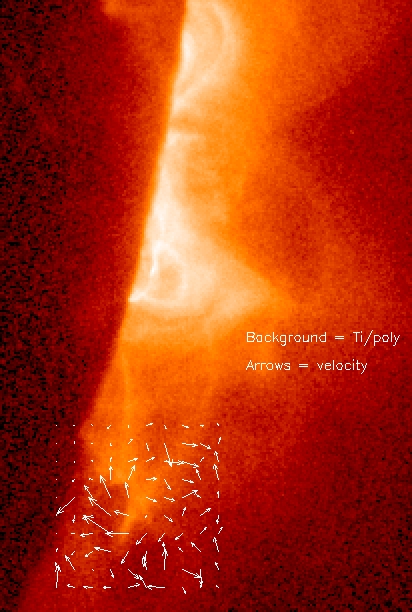
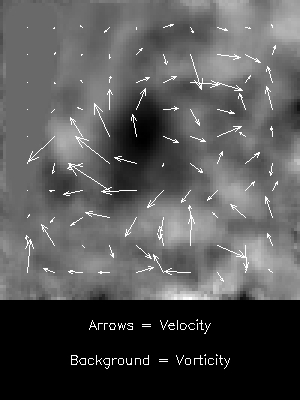
In this paper, motions in
flare plasmas are monitored with Local Correlation Tracking (first time LCT has
been used in the corona, maybe?). The velocity field of the plasma is
determined, and from that a vorticity can be inferred. The paper demonstrates
that recent developments in high-resolution, high-cadence imaging of the corona
make it possible to study turbulence in the flare plasma. Turbulence has long
been the domain of spectroscopy, where turbulence is inferred from nonthermal
broadening of emission lines. Such 1-dimensional studies (i.e., velocities
along the line of sight) have been all that was available. The imagery from
XRT and AIA bring two additional spatial dimensions into play, and combination
of the imagery with spectroscopy offers to complete the set. The reason it
matters is this--- turbulence creates small length scales, and small length
scales enable reconnection. In the words of the Heliophysics Roadmap, it's all
about "the microphysics of magnetic reconnection by determining the kinetic
processes responsible".
Although some dynamic activity was seen in other parts of the
eruptive structure, the most notable feature was
apparent
rotation in the southernmost part of the extended coronal structure,
immediately above the limb. The LCT allows the velocity field to be mapped,
and then one can explore the plasma motion via either Eulerian or Lagrangian
techniques. As an example, the vorticity has been calculated in this rotating
feature (context and
vortex map).
2013-January-16
New XPOW:
Fifteen Active Regions in One Image
2013-January-04
New XPOW:
C-Flare from Sigmoidal AR 11608
2012-December-17
New XPOW:
Long-Duration B-Flare from AR 11598
2012-December-10
New XPOW:
Sweeping Active Region Jet
2012-November-28
New XPOW:
X-Ray Bokeh
2012-November-21
New XPOW:
Rolling Void in AR 11563
2012-November-20
Press coverage:
Wired Science has an article entitled
5 Years of Incredible X-Ray Explosions From the Sun, which features
an XRT video.
2012-November-14
New XPOW:
Solar Eclipse of November, 2012
2012-October-31
New XPOW:
Massive Filament Eruption from 2012/08/31
2012-October-18
New XPOW:
C-flare on Sept 27, 2012 (Filament Eruption)
2012-October-05
Calibration event:
XRT will be running a 72-hour CCD Bakeout, starting Tuesday, Oct.
9 (UT). There will be no science data taken during this time period.
2012-October-03
Monthly Science Highlights:
Each month we highlight recent XRT science papers. A
PDF summary of the highlights is available. The papers themselves
are ADS-linked below (when possible):
-
"Observations and Magnetic Field Modeling of a Solar Polar Crown
Prominence"
Su & van Ballegooijen 2012,
ApJ, 757, 168
-
"The Cold Shoulder: Emission Measure Distributions of Active Region
Cores"
Schmelz & Pathak 2012,
ApJ, 756, 126
-
"X-ray emitting hot plasma in solar active regions observed by the SphinX
spectrometer"
Miceli et al. 2012,
A&A , 544, 139
-
"SphinX Measurements of the 2009 Solar Minimum X-Ray Emission"
Sylwester et al. 2012,
ApJ, 751, 111
-
"On the Nature and Genesis of EUV Waves: A Synthesis of Observations from
SOHO, STEREO, SDO, and Hinode: (Invited Review, The Sun 360)
Patsourakos & Vourlidas 2012,
Solar Physics, Online First, May 2012
-
"Asymmetric Magnetic Reconnection in Solar Flare and Coronal Mass Ejection
Current Sheets"
Murphy et al. 2012,
ApJ, 751, 56
-
"Sigmoidal Active Region on the Sun: Comparison of a Magnetohydrodynamical
Simulation and a Nonlinear Force-free Field Model"
Savcheva et al. 2012,
ApJ, 750, 15
2012-September-25
New XPOW:
Synoptics Surrounding Sympathetic Filament Eruptions
2012-September-15
New XPOW:
5.5 Years of XRT Synoptic Observations
2012-August-31
New XPOW:
Beautiful Candle Flame Cusp on the Limb
2012-August-27
New XPOW:
Filament Eruption with Supra-Arcade Downflows
2012-July-31
New XPOW:
X1.4 Flare of July 12, 2012
2012-July-24
New XPOW:
July Fireworks
2012-July-09
New XPOW:
High Cadence Flare Response with Long/Short Exposure Composites
2012-July-02
New XPOW:
The Emergence of Active Region 11512
2012-June-19
New XPOW:
Eruptive Flare with High-Cadence Response (2012/04/30)
2012-June-07
New XPOW:
The Transit of Venus
2012-May-30
New XPOW:
Wandering Field Lines During Filament Eruption
2012-May-21
New XPOW:
Solar Eclipse of May 20th, 2012
2012-April-18
New XPOW:
Supra-Arcade Downflows After Long Duration B-Flare
2012-April-11
New XPOW:
Hot Non-Potential Core in AR 11433
2012-April-03
New XPOW:
X-Points, Loop Expansions, and Cusp Loops
2012-March-27
New XPOW:
Possible Slip-Running Reconnection on 2012/03/25
2012-March-19
Monthly Science Highlights:
Each month we highlight recent XRT science papers. A
PDF summary of the highlights is available. The papers themselves
are ADS-linked below (when possible):
-
"Field Topology Analysis of a Long-lasting Coronal Sigmoid" Savcheva,
van Ballegooijen & DeLuca 2012, ApJ, 744, 78
- "Sigmoidal Active Region on the Sun: Comparison of a Magnetohydrodynamical
Simulation and a Non-Linear Force-Free Field Model"
Savcheva, Pariat, van Ballegooijen, Aulanier, & DeLuca 2012, ApJ, in press.
2012-March-19
New XPOW:
X-Ray Jet on 2012/03/16
2012-March-07
New XPOW:
Three X-Flares in Two Days from AR 11429
2012-February-21
Conference Announcement:
The
Hinode 6th Science Meeting will be held in St. Andrews, Scotland,
on August 13--17, 2012. The deadline for abstract submission is 30 June 2012.
The deadline for registration is 30 June 2012.
2012-February-10
New XPOW:
Supra-Arcade Downflows Post X-Flare (2012/01/27)
2012-February-9
Breaking News! XRT-CO Antonia Savcheva (BU) has passed
the oral part of her PhD comprehensive exams.
We expect her thesis to be done in about a year from now.
Congratulations from the Hinode / XRT Team, Antonia!
2012-February-7
XRT makes it to NASA Image of the Day!:
Hinode/XRT caught a large flare on the limb of the Sun, and
one of our images was featured as the NASA Image of the Day for
2012-February-7.
2012-February-6
Monthly Science Highlights:
Each month we will highlight three recent XRT science papers. A summary of the
papers is given
HERE . The papers themselves are ADS-linked below:
-
"Thermal Properties of a Solar Coronal Cavity Observed with the X-Ray
Telescope on Hinode" Reeves et. al 2012, ApJ, 746, 146
-
"Clear Detection of Chromospheric Evaporation Upflows with High
Spatial/Temporal Resolution by Hinode XRT" Nitta et. al 2011, Solar
Phys., 276, 183
- "Lateral Offset of the Coronal Mass Ejections from the X-flare of 2006 December 13 and Its Two Precursor Eruptions" Sterling et. al 2011, ApJ, 743, 63
2012-January-25
New XPOW:
Highly Flare Productive AR Complex - 2012/01/22 Synoptic
2012-January-19
Conference Announcement:
The Hinode 6th Science Meeting will be held in St. Andrews, Scotland,
on August 13--17, 2012. (We will announce a meeting website when
one becomes available.)
2012-January-18
New XPOW:
Can you spot Comet Lovejoy?
2011-December-9
Operational announcement:
Regarding the MDP bit-error of 2011-December-7:
The MCU reset related to the MDP 2-bit error recovery was successfully
performed. XRT can resume normal observations on Saturday evening (JST).
2011-December-7
Operational announcement:
A bit error has been detected in the MDP (Main Data Processor of
the spacecraft). This happens occasionally, and the recovery is
routine. However, there won't be any observations during the Thursday
timeline period. Observations are expected to resume on Saturday
evening (JST).
2011-December-2
New XPOW:
The Partial Solar Eclipse of 2011/11/25
2011-October-20
Group photo from the Hinode 5th Science Meeting,
hosted by SAO/XRT.

2011-October-4
2011 Flare catching statistics:
Kathy Reeves has compiled some statistics on XRT's success rate on
catching large (X- and M-class) flares in calendar year 2011, so far. The
presentation will be made to the Hinode Science Working Group Meeting
on Oct. 10. Here are a few:
- 58%: Percentage of large flares observed by XRT.
- 16%: Percentage of large flares missed because instruments watching a different target on the Sun.
- 9%: Percentage of large flares missed because no observations planned at the time.
- 58%: Percentage of flare triggers that caught pre-flare data when XRT was pointing at the right target. (Most common reason for missing this is when multiple flare triggers in a row lock out the pre-flare buffer.)
2011-September-13
Education / Public Outreach: XRT
E&PO DVD now available free upon request:
The Hinode/XRT Team has put together a DVD product called The XRT
Education & Public Outreach DVD: Space Science Careers: Building
Hinode XRT, A Space X-ray Telescope. This package is available
free upon request.
Product description
Product order form
From the product description:
"Space Science Careers: Building Hinode XRT, A Space X-Ray
Telescope is a resource for high school guidance counselors and
others who provide career awareness information to high school
students. The goal of Space Science Careers is to introduce students
particularly those who might be interested in technical careers to
the diversity of career opportunities at NASA and in the space
industry...
"Space Science Careers embeds career awareness in video clips that document the construction of an X-ray telescope... that was launched into Earth orbit on the Hinode satellite on September 23, 2006. The resource provides students with a unique window into the workplace and an unscripted view of workers collaborating and solving problems as they attend to their specialties."
2011-August-24
Education / Public Outreach: XRT Team Member Kentaro Yaji-san sends us this news:
Dear all

This is Kentaro Yaji.
Thank you for everybody efforts for HOP173 observations.
This highly encouraged the high school students.
The following is the homepage for HOP173 EPO campaign observation
Sorry in Japanese.

http://www.rikkyo.ne.jp/web/yaji/hinode/hop173/

The title of this page represents "Let's observe the sun with Hinode!"
I don't sufficiently update the images taken by high school students.
But there is a list of high school in the last part of the homepage.
If you click the high school name, you might be see some solar images.

In the following, the observation results of last year are previewed.

http://www.rikkyo.ne.jp/web/yaji/hinode/hop173/hop173_preview.html

Regards,
Thank you.

------------------------
Rikkyo University
Kentaro Yaji
2011-August-24
Operational announcement: Filter wheel
1 (FW1) has been returned to automatic control mode. During spacecraft
eclipse season, FW1 is put into a manual control mode to mitigate
against possible lock-ups. Now that eclipse season has ended, FW1
has been returned to a mode where all of its filter positions can
be freely used by the observing tables.
2011-August-5
Data gap: XRT temporarily stopped
taking data around 11:17 UT on July 28. It has been determined
that there was an error made in a table upload. Apart from missing
a few days' worth of data, there have been no negative consequences
of this error, and there was never any risk. Observations resumed
around 10:38 UT on August 4.
2011-July-13
Job Announcement: The Solar and Stellar X-ray
Group at SAO is hiring for an Astrophysicist position. Details on
the job, qualifications and the application process can be found
here:
SAO Job#11-46.
The application deadline is being extended to July 31.
2011-July-13
The abstract deadline for the
Hinode-5
Science Conference has been extended to August 15.
2011-May-24
Hinode-5
(The Fifth Hinode Science Conference) will be held in
Cambridge, MA, October 10--15.
The registration for the Hinode 5 meeting is now open:
http://hinode5.cfa.harvard.edu/Registration/.
July 1, 2011 is the deadline for early registration, abstract
submission, and housing. Mark your calendars!
More information at the Hinode 5 website:
http://hinode5.cfa.harvard.edu/.
2011-May-5
Job Announcement: The Solar and Stellar X-ray Group at SAO is hiring for a Research Assistant position.
Details on the job, qualifications and the application process can be found here:
http://www.cfa.harvard.edu/hr/postings/11-40.html
2011-Apr-14
Big News: Next week, Hinode-XRT operations will
resume regular two-day timelines.
2011-Mar-21
Big News: Due to interruptions in power at
JAXA/ISAS and in Tokyo, we have had to simplify the Hinode-XRT
operations for the short-term future. Single timelines will
encompass several days of operations. As a consequence, Hinode-XRT
planners will not be able to respond to rapidly changing conditions
on the Sun during this period. However, on-board response functions
(such as automatic exposure control and flare response tables)
continue to operate nominally, and there is no impact to the safety
of the instrument. We will keep you informed on this website as the
operations conditions change.
2011-Mar-21
Major Update: March 11 Letter from Hinode-XRT PI
to Japanese Colleagues regarding earthquake and tsunami.
Dear Japanese Colleagues,
We are shocked and horrified at the damage that has been shown from the earthquake and tsunami. I am sure that many members of the Japanese solar community have been affected either directly or indirectly by the disaster. If there are actions that the US community can take to ease the burden during the coming weeks, please let us know. You are in our thoughts and prayers.
Sincerely,
Ed DeLuca
[Hinode-XRT PI]
[March 11, 2011]
2011-Feb-10
"Hinode Looks into a Hole on the Sun":
An XRT image (Ti/poly) from Feb.1 is featured on the NASA/Missions/HINODE
page this week.
(The feature page is here.) UPDATE 2011-Feb-14: The feature is also being
carried by Fox News now:
"Scientists Discover Giant Holes in the Sun".
2011-Feb-03
The paper "Quantitative Examination of a Large Sample of Supra-Arcade
Downflows in Eruptive Solar Flares", by S.Savage and D.McKenzie,
has recently been accepted for publication in The Astrophysical
Journal. Expected publication is March 20, 2011, V730.
2011-Feb-03
Recently, XRT took 9-filter synoptic observations on Jan 5 (12 UT),
Jan 9 (20 UT), and Jan 13 (20 UT). We compared them with the
corresponding images taken by SDO/AIA. The results can be found
HERE.
2011-Jan-04
XRT observed an annular eclipse on January 4, at approximately 9:16 UT. An image and a movie of
the eclipse can be found on the XPOW page.
2010-Dec-17
XRT operations have resumed using Filter Wheel 1 for high-cadence
filter switching. This wheel contains thin filters (Al-poly and
C-poly), as well as some of the thin/medium filters (Be-thin, Al-med,
and Be-med). The latter are particularly useful for active region
observations.
2010-Dec-8
The paper "Temperature distribution of a non-flaring active region
from simultaneous Hinode XRT and EIS observations", by Testa P.,
Reale F., Landi E., DeLuca, E.E., and Kashyap V., has recently been
accepted for publication in
The Astrophysical Journal. (Here's the link to the arXiv.org
entry:
http://arxiv.org/abs/1012.0346 .)
2010-Dec-1
The paper "Coronal Temperature Diagnostic Capability of the
Hinode/X-Ray Telescope Based on Self-Consistent Calibration", by
N. Narukage, T. Sakao, R. Kano, H. Hara, M. Shimojo, T. Bando, F.
Urayama, E. DeLuca, L. Golub, M. Weber, P. Grigis, J. Cirtain, and
S. Tsuneta, has recently been accepted for publication in The Astrophysical
Journal.
2010-Oct-28
The paper "The Role of Magnetic Topology in the Heating of Active Region Coronal Loops,"
by J.-Y. Lee, Graham Barnes, K.D. Leka, Katharine Reeves, K. Korreck, L. Golub, and E.E. DeLuca,
has recently been published in The Astrophysical Journal.
2010-Oct-21
Big News! XRT-CO Sabrina Savage (MSU) successfully
defended her PhD thesis!
Congratulations from the Hinode / XRT Team, Dr. Sabrina Savage!
2010-Oct-18 The Hinode Science Working Group (SWG) has announced that the Hinode-5 Science Meeting will be in Cambridge, Massachusetts, on October 11--14.
2010-Oct-18 XRT got nice observations of the M2.9 class flare at 19:02 UTC on 10/16, including pre-flare buffer images!
2010-Sep-10
Major News! Important calibration update
Dear Friends of XRT,
The XRT team has produced and released a substantial upgrade to the analysis software. This new release contains code that corrects for time dependent contamination of the XRT analysis filters and adjusts filter thicknesses to be consistent with the thorough analysis done by Narukage et al. (2010 Solar Physics, submitted). New tools for temperature and emission measure analysis are also included in this software release. Extensive documentation of these routines are contained in the program header information and descriptions of many of the XRT analysis tools are given in the XRT Analysis Guide (found at http://xrt.cfa.harvard.edu/resources/documents/XAG/XAG.pdf). All of the new software and associated data base files have been upload to the SolarSoftWare distributions site. Users of XRT data should be sure that their SSW IDL libraries are up to date.
Please send questions and report any bugs to xrt_manager [at] cfa.harvard.edu.
Note that the changes may take a day or two to percolate through SolarSoft.
Regards,
Kathy Reeves
XRT Project Scientist
2010-Sep-03 XRT image headers have a keyword, FLFLG, which indicates if the XRT flare flag has been set. The FLFLG keyword tells you if the XRT flare flag tripped but it does not tell you if XRT responded to the flare flag. As of reformatter version 1.52, beginning with images from about 2010/08/10 07:59, we have also added a new keyword, OBS_MODE, in order to indicate if XRT is running a flare mode program or a normal (quiet) mode program. This keyword is set to 'QT' if XRT is running a normal mode program and 'FL' if XRT is running in flare mode.
The OBS_MODE keyword does not exist in images processed before 2010/08/10, and the FLFLG keyword was not set correctly during a flare trigger in these prior images as well. We are working to update the XRT back catalog with correct information. In the meantime, the times when the XRT flare flag tripped, and information about whether or not XRT responded, can be found here: http://xrt.cfa.harvard.edu/missionops/flare_trigger_list/xrt_flare_flags.txt.
Please send any questions or concerns to xrt_manager_at_head.cfa.harvard.edu .
2010-Sep-03 The paper 'Multi-Stranded and Multi-Thermal Solar Coronal Loops: Evidence from Hinode X-Ray Telescope and EUV Imaging Spectrometer Data', by J.T. Schmelz, S.H. Saar, K. Nasraoui, V.L. Kashyap, M.A. Weber, E.E. DeLuca, and L. Golub, has been accepted for publication in The Astrophysical Journal.
2010-Aug-20 The XRT Team has just released a new upgrade to the basic XRT calibration
program xrt_prep.pro. (It should appear in the SSW tree in the next
few days.) The new version allows the user without a
local XRT data archive to setup automatic copying over the web of
darks required for the best (default) dark subtraction. The new
version also reduces error messages when files are not found, and
uses 512x2048 "strip darks" to approximate 2048x2048 darks in the
calibration for more recent 1x1 binned data (as 2048x2048 1x1 binned
darks are now rare due to telemetry issues). See the program headers
for more details.
Comments, feedback, and bug reports regarding these routines may be
directed to this email address: xrt_manager_at_head.cfa.harvard.edu
2010-Aug-10 The paper 'Reconnection Outflows and Current Sheet Observed with Hinode/XRT in the 2008 April 9 "Cartwheel CME" Flare,' by S. Savage, D. McKenzie, K. Reeves, T. Forbes and D. Longcope has been accepted for publication in The Astrophysical Journal. A preprint can be found at on the arXiv preprint server at: http://arxiv.org/abs/1003.4758.
2010-July-26: A new X-Ray Picture of the Week is available! This movie shows AR11087 as it was observed coming around the East limb on July 09, 2010. This active region produced several C-class flares during its peak of activity from July 8-11th. It was also associated with CMEs observed by SOHO/LASCO on both July 8th and 9th. This movie shows one of the C-flares, pre and post-flare loop brightenings, as well as some hints of the ejected material that may have been observed by LASCO.
2010-July-11: XRT observed the July 11 2010 solar eclipse. This eclipse was visible from the South Pacific, and XRT/Hinode participated in joint observations with eclipse observers in The Cook Islands, French Polynesia, and Easter Island. A set XRT images from the eclipse can be found on the X-Ray Picture of the Week (XPOW) page.
2010-May-02: The 2010 Hinode/XRT team meeting will bring
together members of the Hinode teams and other scientific investigators
to discuss technical issues of XRT, scientific results, and plans
for future observations. The dates of the meeting are June 16
(Technical Discussion) and June 17-18 (Science Discussion), and the
location is Montana State University in Bozeman, Montana. The SOC
solicits your abstracts for this meeting. For additional information,
and the full announcement, please visit the meeting website at
http://solar.physics.montana.edu/HINODE/XRT/TeamMtg/.
2010-Mar-30: The calibration database for the CCD contamination layer has been updated; it is now current up to 2010-Feb-19. (This database is automatically accessed by the XRT SolarSoft code make_xrt_wave_resp.pro, which can be used to calculate the time-dependent effective areas.) Our intention is to update the database regularly after bake-outs. An improved analysis was used to recompute the layer thickness; users will note some changes in the computed thicknesses for data times before 2007-Sep-08.
2010-Jan-20: XRT observed the eclipse of Jan-15-2010. A movie of the moon eclipsing an active region can be found on the X-Ray Picture of the Day Page.
(2009-Dec-03)
XRT is currently operating Filter Wheel 1 in "stepper mode". FW1 is currently set to the Al-med position. Early next week, FW1 will be moved to the Open position until further notice.
(2009-Nov-13)
XRT observations have resumed at 2009-Nov-13, 0900 UT.
(2009-Nov-11)
IMPORTANT--- XRT observations are expected to resume on the Saturday timeline (2009-Nov-14).
(2009-Nov-03)
IMPORTANT--- XRT observations were halted on October 23, 2009, in order to perform some instrument tests. The date for resuming observations has not yet been set, and is pending the results of the testing.
(2007-Aug-30)
The XRT CCD has experienced some degradation due to contamination that appeared after a short CCD bake-out in July. The contamination is manifest by small (~5 pixel diameter) spots on the detector. The spots cover somewhat less than 4% of the CCD area.They are seen in G-band images and in the thinner x-ray filters (Al_mesh, Al_poly, Ti_poly, C_poly and Be_thin, with decreasing effect in the order listed). The origin of the contamination is not understood at this time.
The XRT team is modifying the software in the SSWIDL tree to give scientists two ways of analyzing XRT data taken after the contamination event:
(1) a "touch-up" program that will replace the affected pixels with an average signal from near-by unaffected pixels.
(2) a "bad-pixel" map that allows scientists to avoid using the affected pixels in their analysis.
The touch-up program is applied to the quick-look images that are being distributed to web-pages and should be used when constructing movies and studying morphological changes. This same program will be available as a switch to the XRT_PREP code that converts level 0 data to level 1 data.
The XRT team is working to develop a cleaning program that will preserve the photometric information available below the spots. This programs will be distributed to the XRT user community through the SSWIDL distribution.
In addition the XRT team will develop programs that correct for the decrease in "filter-dependent" transmission between Nov-2006 and July-2007 caused by the accumulation of contaminants on the CCD. These corrections are particularly important for scientists using XRT data to estimate temperatures (e.g. via filter ratios).
The XRT team has setup an email distribution for users of XRT data. To subscribe to this list send an email to: xrt_users-request@head.cfa.harvard.edu To reduce the amount of spam on this list, users are accepted by positive confirmation at SAO. Please include your signature file when requesting admission to this list. The XRT team will use the list to keep the community up-to-date on the latest analysis tools and developments. Users may use this list to ask questions about analysis, report bugs and discuss analysis techniques with other users. Email to this list will be archived at: xrt_users off the community page.
(2007-Aug-13) XRT is undergoing extended bakeout. Scientific observations are minimized during this period, and scheduled externally requested observations are deferred. The length of the bakeout period has not yet been determined, at this time.
Lots of press coverage after a recent NASA Science Update. For instance, see Rueters.
XRT's magnificent view of the Sun was featured in the November 11, 2006 issue of Science News. Science News Website
XRT's stunning view of the Mercury Transit is featured at Science@NASA. NASA Science News for November 17, 2006
Hinode's First Light was featured at Science@NASA. NASA Science News for November 02, 2006
Read about Hinode's early operations and near future plans. JAXA Space News October 31, 2006